




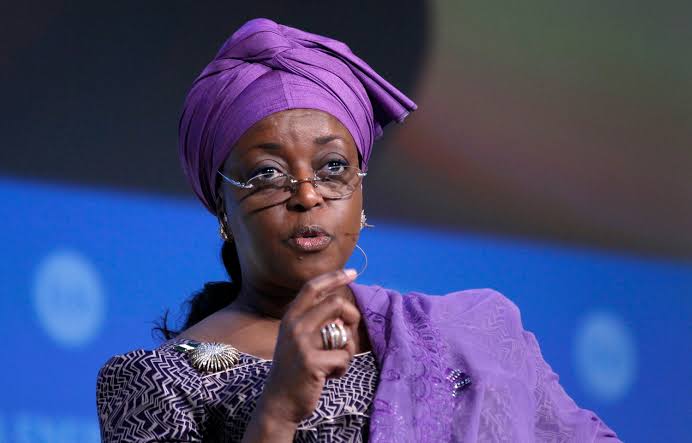
A London jury at Southwark Crown Court has cleared Nigeria’s former Minister of Petroleum Resources, Diezani Alison-Madueke, of all six charges she faced. It closes an 11-year UK investigation but “not guilty in London” is not the same as “case closed” and in Nigeria, the financial trail is still being litigated in court.
Before the corruption headlines, she broke barriers. Diezani Alison-Madueke joined Shell Petroleum Development Company in Nigeria in 1992 and became Shell Nigeria’s first female executive director in 2006. From there: Minister of Transport, then Minister of Mines and Steel Development, then Minister of Petroleum Resources in 2010 under President Goodluck Jonathan.
In 2014, she became the first woman to lead Organization of the Petroleum Exporting Countries (OPEC).
The petroleum ministry isn’t an ordinary cabinet post. In Africa’s largest oil producer, it sits on top of the revenue stream that funds most of government spending.
For five years, Alison-Madueke oversaw a sector responsible for the bulk of Nigeria’s foreign exchange earnings.
That scale is exactly why the allegations against her, and the numbers attached to them, got so many.
British prosecutors built their bribery case against Alison-Madueke on a meticulous paper trail of receipts, invoices, and testimonies tracking exactly where oil-contractor funds went between 2011 and 2015.
Instead of one single lump sum, the prosecution highlighted a pattern of systemic luxury:
• Real Estate & Refurbishments: Businessman Kolawole Aluko allegedly funded over £2 million in Harrods purchases and £4.6 million in London and Buckinghamshire property renovations, including installing a residential lift for her mother.
• High-End Furniture Shopping: Court evidence detailed a single-day £140,000 antique shopping spree and over £370,000 in Mayfair gallery invoices; all paid through intermediaries or settled on Aluko’s cards.
• Designer Perks & Lifestyle: The indictment tracked routinely funded luxury, including Louis Vuitton goods, stays at £2,500-a-night London hotels (The Savoy, Dorchester), private jet flights, and her son’s school fees.
The prosecution summarized this paper trail as a textbook exchange: a lavish “life of luxury” directly funded by businessmen seeking favorable treatment on lucrative oil and gas contracts.
Her legal team argued the spending was either reimbursed official expenditure or her own money, and that she had limited direct authority over contract approvals. They explained that operational power sat mainly with NNPC’s leadership, not the ministry.
A written statement from former President Goodluck Jonathan was read to the court confirming it wasn’t unusual for third parties to cover ministerial expenses on foreign trips, and that he had personally approved her use of private jets for official travel. Her lawyers also argued that an 11-year delay in bringing charges meant key evidence supporting her innocence had been lost.
On June 17, 2026, after a five-month trial and more than 46 hours of jury deliberation, the jury returned not-guilty verdicts on all six counts.
Oil executive Olatimbo Ayinde and Alison-Madueke’s brother, Doye Agama (both co-defendants) were also acquitted. It brings the UK’s 11-year criminal investigation to a formal close but “acquitted” is a legal term with a specific meaning, and that’s worth explaining.
An acquittal means the prosecution failed to prove guilt beyond reasonable doubt. It does not mean a court found her innocent, and it does not mean the allegations were proven false.
Both things can be true at once: the state can fail to meet its legal burden, and unresolved questions can still exist.
This distinction matters because Nigeria’s other proceedings against her (the asset forfeiture cases) use a different legal standard entirely (civil, not criminal), which is why those cases can continue even after a criminal acquittal elsewhere.
Read Also: How NNPCL could not account for “missing” N210 trillion
The Economic and Financial Crimes Commission (EFCC) has consistently alleged she facilitated the loss of about $2.5 billion in oil-sector revenue during her tenure; that’s the core domestic allegation.
Separately, former Central Bank governor Sanusi Lamido Sanusi alleged $20 billion went missing from NNPC under her oversight. This is a claim about the broader corporation, not a personal bribery figure, and one she has dismissed as retaliatory.
Of recovered, verifiable money, the EFCC says it has recovered roughly $153 million in cash and assets domestically, plus over 80 properties valued around $80 million.
In January 2025, the US repatriated a further $52.88 million tied to the forfeited superyacht “Galactica.” Total alleged versus total recovered is a massive gap and that gap is the real story.
In October 2021, Nigerian media reported the EFCC had listed assorted personal items, including bras, among assets forfeited by Alison-Madueke. Within days, social media had transformed this into a viral claim: a “$12.5 million diamond-encrusted bra” recovered from her apartment.
It spread for weeks, became a defining image of her case for millions of Nigerians, but it was completely fabricated; built from recycled photos of a Victoria’s Secret runway piece.
In November 2021, EFCC chairman Abdulrasheed Bawa personally and publicly denied it on TVC’s “Your View,” stating plainly that no such item existed and that, as lead investigator, he would have known. Fact-checkers at Daily Trust and Dubawa had already debunked it before his statement.
More Claims That Need Context
The diamond bra isn’t the only figure that got inflated along the way. Some claims attributed to unnamed US and UK officials in a 2015 broadcast suggested she may have personally organized a $28 billion diversion.
It is worth knowing that this figure was never substantiated in any court filing and shouldn’t be treated as established fact.
In 2009, before she became petroleum minister, Nigeria’s Senate indicted her over a ₦1.2 billion transfer linked to a toll concession breach.
None of this excuses real, documented allegations but conflating unverified numbers with proven ones makes it harder to hold anyone accountable.
Here is the reality behind a viral claim that Diezani Alison-Madueke personally stole $90 billion.
The $90 billion figure still remains alleged as there are no court filing behind it anywhere but the official financial loss alleged by Nigerian authorities is $2.5 billion in facilitated revenue leakage during her tenure as petroleum minister and thus remains unrecovered in full.
Also, verified recoveries across Nigeria and the US exceed $280 million, including roughly $153 million in cash domestically, more than 80 forfeited Nigerian properties worth about $80 million, and a further $52.88 million repatriated from the United States in January 2025 from the sale of the Galactica Star superyacht. That $280 million was recovered because investigators in three countries traced it back to her tenure.
A jury acquittal in one courtroom on a specific charge of receiving lifestyle gifts does not erase a documented gap between an alleged $2.5 billion in lost oil-sector revenue and roughly $280 million recovered. These verified numbers are very damning as Nigerian authorities might seek to extradite the former Minister.
The London acquittal closed one criminal case, on one narrow set of charges, in the UK but it is seperate from proceedings still sitting in Nigeria, where the money was actually taken from.
• The Criminal Case: The EFCC arraigned Alison-Madueke in absentia in Nigeria in 2018 on a 13-count charge sheet that remains formally on the books. The EFCC has issued no public statement on whether it will proceed to trial, and that silence is itself worth scrutinizing: a case built on Nigerian evidence about Nigerian public money should not depend on what a London jury decided about a different, narrower bribery charge.
• The Civil Asset Case: Diezani is actively contesting the EFCC’s final forfeiture orders at the Federal High Court in Abuja, in a suit filed in 2023 (FHC/ABJ/CS/21/2023) arguing she was denied a fair hearing before more than 80 properties and other assets were seized. The court fixed the matter for hearing as recently as October 2025, and proceedings continue.
This case is not about whether she is innocent but about whether assets the EFCC says are proceeds of corruption get to stay forfeited.
An acquittal in London on specific bribery counts changes nothing about a forfeiture fight over assets the Nigerian state says were bought with stolen public money.
The $52.88 million repatriated from the US in January 2025 came from forfeiting the superyacht Galactica Star, legally owned by businessman Kolawole Aluko.
While Alison-Madueke’s lawyer, Mike Ozekhome SAN, has publicly denied her connection to the vessel, stating she never saw it and that Aluko bought it independently, US prosecutors tell a different story.
The US Department of Justice (DOJ) civil forfeiture case directly names her, alleging that Aluko and fellow businessman Jide Omokore bribed her between 2011 and 2015 for lucrative oil contracts. According to the DOJ, they then laundered over $100 million of those proceeds into US real estate including a $50 million Manhattan condo, and the yacht itself.
Disputing legal ownership of a yacht does not erase, the far more damning allegation that the money used to buy it was contract bribes, paid in exchange for oil revenue that belonged to Nigerians, not to her or her associates.
Prosecutors allege this fits a broader pattern in the case: that assets were registered under associates’ names rather than Diezani’s own; a structure they say would have shielded a sitting petroleum minister from a paper trail leading directly back to her.
The UK criminal case is over but the Nigerian civil forfeiture case continues, unresolved, more than a decade after she left office.
No criminal conviction has been secured against her anywhere in the world as of today.
For anti-corruption advocates, that’s a sobering data point about how difficult it is to prosecute politically connected figures across borders and over long timeframes, regardless of how strong public belief in guilt may be.
Four things can be true simultaneously:
• a jury found the prosecution didn’t meet its burden of proof in London
• a separate criminal case and a separate civil forfeiture case remain genuinely open in Abuja
• years of viral misinformation have made it harder for the public to track which claims were ever real
• the documented gap between roughly $2.5 billion allegedly lost and roughly $280 million recovered leaves open the question of how much, if any, additional money may never be fully traced or accounted for.
Real accountability will come from the Abuja courtroom but it also requires not letting an acquittal in one jurisdiction quietly close the book on a financial trail that, by the government’s own numbers, is still missing the vast majority of what it alleges was taken.
Knowing the difference between what’s proven, what’s alleged, and what’s invented is the whole point of following this story responsibly.


